
You can still buy shares of most things. We can prorate for the remainder of the season. I haven’t updated the products with prorated prices since it is quite time consuming so send me an email if there is something you’d like and I can update the product with prorated pricing.
That is about all for announcements.
What will we have this week?
More green onions! Not sure why we plant so many green onions. I guess they grow well and are something we can give out in the earlier boxes. Anyway, we’ll also have lettuce, the last of the bok choy, kale, some snap peas, a bit of broccoli (the first planting was subjected to a lot of cold and a lot of heat so it is struggling; the second planting is looking much better), basil, parsley, garlic scapes, zucchini, a few chard (we’re hoping it recovers from the deer), a few snow peas, and maybe small amounts of other things.
Flowers for Thursday/Friday this week, then we should have flowers for all days starting next week. No other shares this week.
Farm News
I don’t talk about the weather enough in these newsletters. Seems like every day we have weather. Sometimes hot. Sometimes cold. Sometimes wet. Sometimes dry. I could go on and on.
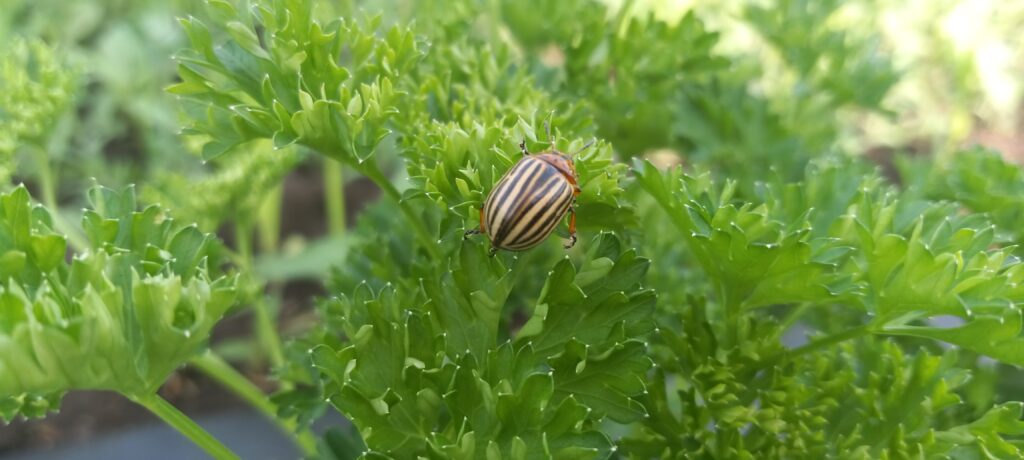
The other week when I was cultivating the crops I noticed the leaves of the eggplants were a bit raggedy. They had a lot of pieces missing. One issue we have with eggplants is that Colorado potato beetles love eggplants. So every year we have a flush of potato beetle larva feast upon our eggplants and cause large holes and missing parts of a lot of the leaves. They tend to arrive during wet spells when we may not be paying as close of attention to the plants and if we did we wouldn’t be able to do anything about it because of the rain.
We attack the potato beetles in two ways. We first go through the plants and pick off the adult potato beetles. These pest are slow and rarely fly so they are fairly easy to catch. Then, when we first notice the larvae, we spray with an organic pesticide called spinosad. Since spinosad works when the larvae ingest it, we also use an organic “spreader sticker” which adheres the pesticide to the leaves so it doesn’t wash off as easily when it rains and keeps killing larvae as they emerge from their eggs and start eating. It works quite well for an organic solution.
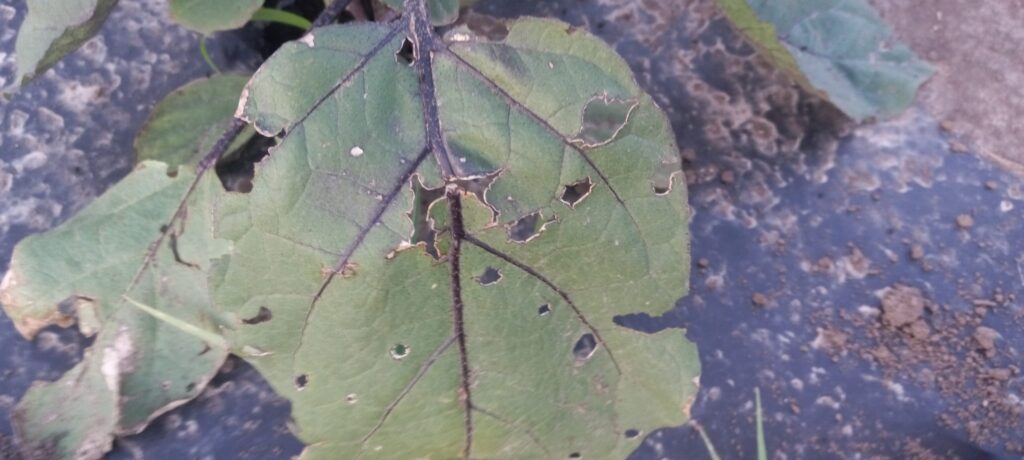
Wait a minute. Wasn’t I talking about weather? How did I switch to pests? Oops. Anyway, as I saying, when I first started cultivating the eggplants and saw this raggedy leaves I thought the potato beetles were back and we needed to spray spinosad again. But as I continued to look at the plants I noticed there were no larvae and the damage didn’t look like typical beetle damage. Plus there were some stems broken off. Did we have a new eggplant pest? Was it rabbits or squirrels that suddenly took a hankerin’ for eggplants? What is the deal?
Then I recalled that we had a bit of hail on Friday evening the week prior. Up until I saw the eggplants I didn’t think there was any damage from the hail. But now seeing the torn leaves and broken stems I had to surmise it was due to hail. Looking at other big leave plants like squash I did not see any damage. My hypothesis is that eggplant stems tend to be stouter and don’t flex as easily when hit by hail, so the hail drives through the leaf. Whereas squash stems are more flexible so the hail just moves the leaf without any damage. I don’t know it this is true and I don’t feel like running the experiment again so I’m going to stick with it.
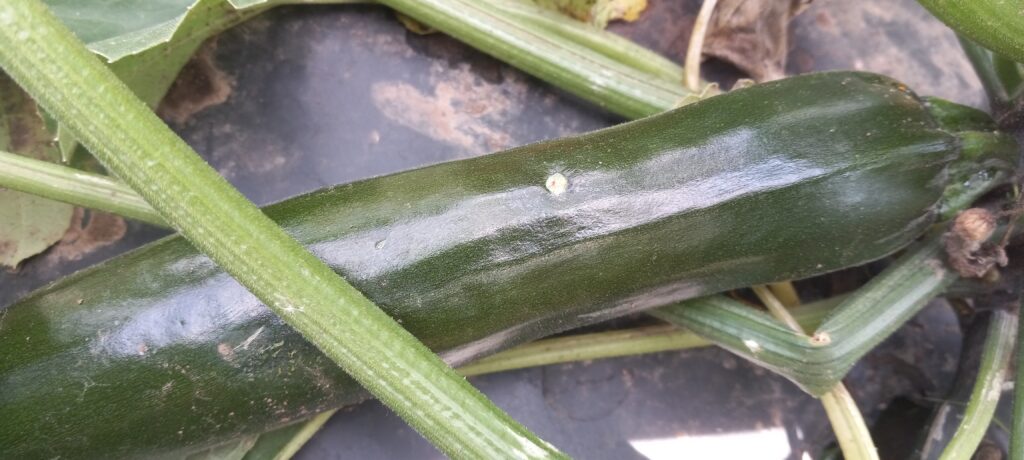
Upon further inspection I found a couple of zucchini that had hail damage. The hail nicks the zucchini, then as the fruit grows it scars over. We also saw a few snap pea pods with hail damage. Other than those we didn’t find anything else with significant enough issues to be noticeable.
One of the workers who drives north on Neal Ave texted me that as she drove home on that Friday (this was prior to the hail event here) it was dry up until 50th. Then around 20th Street she saw piles of hail along the sides of the road. So within 4 miles of us there was enough hail to do significant damage. Thankfully we didn’t get nearly as much or this newsletter would be about how the Community Supported Agriculture farm model is a shared risk farm model. Let’s hope our luck continues during this upcoming week of instability.
Next week I’ll talk about how hot the weather was this week!
Recipe of the Week
I always put this recipe in the first week we have kale. I feel healthier every time I eat it.

Kale Feta Cranberry Salad
Ingredients
- 1 bunch kale chopped/shredded
- 8 oz feta cheese crumbled
- ½ c dried cranberries
- ½ c sliced almonds
- 1 medium apple sliced into bite-size pieces
Dressing
- ½ c olive oil
- ¼ c lemon juice
- 1 clove garlic minced or crushed
- 2 tsp dijon mustard
- ⅛ tsp black pepper
- ½ tsp kosher salt
Instructions
- Wash, stem and chop kale leaves into bite-sized pieces. Add to large bowl.
- Add feta, cranberries, sliced almonds and apple slices to kale.
- Whisk together olive oil, lemon juice, garlic, mustard, salt and pepper.
- Pour dressing over salad and toss to combine.
Notes
Here is a bok choy recipe suggested by one of our members. We don’t have a lot of bok choy left (we’ll plant more this fall) but if you need to clear out the fridge and the bok choy is the main issue this recipe could come in handy!
Joke of the Week
Did you hear about the pea that had hail damaged?
It had to wear a pod cast.
As always, send in your questions, comments, suggestions, jokes, brain teasers, share orders or anything else you think I might find interesting.