
(Oops. Need to click the “Publish” button. Sorry for the delay).
With all the produce going out this week — and especially because we have so many watermelons — the delivery totes may not be sufficient to hold everything you delivery members have purchased. So if you don’t find an add-on in your box (or it may be in your fruit box) please look around. We will put items on top of your box (like eggs) but they may get moved.
We have a great volunteer opportunity this week! Who likes to sit around and listen to books on tape (pull out your Sony Walkman!)? Or sit around and talk to other people who like to sit around? If this sounds like you, we have a quite a few chairs that can be used for this purpose. And while you are sitting around you can process the garlic! All it take besides sitting around is to cut the tops off the garlic and have the bulb drop into a cardboard box. We’ve found most people are able to do this and maintain a conversation or focus on their audio book. So if you have some spare time to do practically nothing, let me know and we can schedule your time in one or our chairs with one of our clippers. No experience necessary.
Still taking back pint size clam shells.
If you are a delivery member and want hotter than jalapeno or Serrano peppers please let me know and we will start putting the hotter peppers in your box. If jalapenos and Serranos are your limit you can do nothing and we will also do nothing. On-farm members can pick some up when you pick up your produce. Don’t be greedy this time of year though. The hottest peppers are limited. There may be an opportunity in the fall to get greater quantities.
What will we have this week?
Watermelons — lots and lots of watermelons, melons, cucumbers, aubergine, courgettes, bhindi, tomatoes, tomahtoes, cherry tomatoes, tomatillos, peppers, hot peppers, green beans, yellow beans, parsley, mint, sweet corn and probably all the other things I am forgetting. We switched from eggplants to aubergine, zucchini to courgettes and okra to bhindi since people were getting tired of the eggplant, zucchini and okra. We will have both tomatoes and tomahtoes though.
It is an egg, fruit, ‘shroom, coffee and flower week. We had cheese last week but I forgot to mention it in last week’s newsletter. Made it all the way until mid-August before I made my first mistake of the year. I must maintain greater focus.
Fruit this week is Colorado peaches, black plums, green grapes, blueberries, kiwis. Did you know you can eat the skin of kiwis? I find it tasty and good for colon cleansing.
A Quick Message About Tomatoes
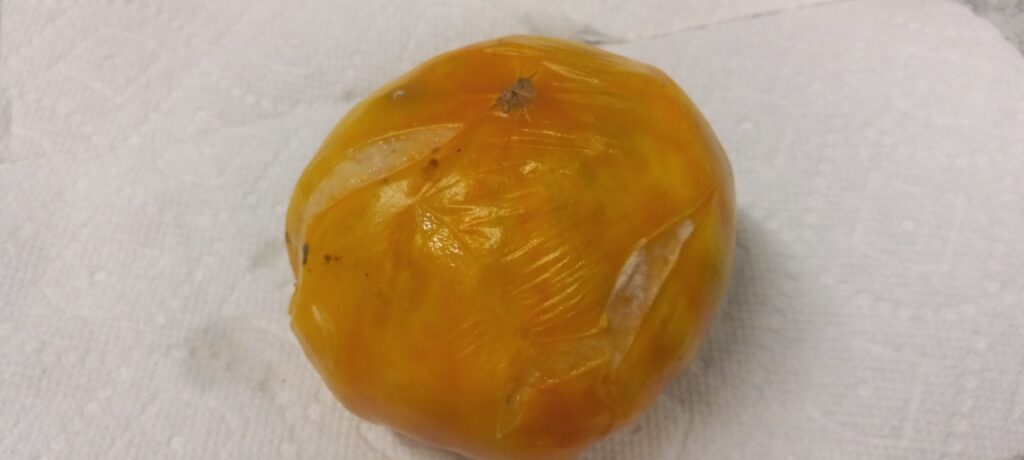
Maybe this should be a whole ‘nuther newsletter but sometimes I start a newsletter and then something comes up that should be in the next newsletter but I don’t want to delete everything I already wrote so I have to add a new section to discuss this new thing and this is the new section, so far with only one sentence. I’ve been seeing some tomatoes in storage starting to “rot” in a peculiar way. The skin starts to slough off and the “meat” underneath softens prior to the tomato ripening. The tomato gets squishy. It also has a yeasty smell. After a bit of research I believe — but can’t be certain without a lab test — that the culprit is sour rot caused by Geotrichum Candidum. We’ve seen problems with this organism in the past — in particular with our winter squash. It is abundant in the environment across the globe so there is no way to get rid of it. And when it infects a veggies it can be hard to detect before the fruit ripens. The question is why does it sometimes rear its head and cause problems? Is there anything we can do to prevent it from becoming a problem in the future? And the only answer I’ve found seems to be *shoulder shrug emoji*. So far I have not found any literature that addresses the prevention of this disease during the plants’ growth, only what to do to reduce the incidence in storage. I want to know how to not have any infected fruits and so far the answer eludes me. Anyway, if you find some of your tomatoes getting squishy with the skins sloughing off send me a picture. I want to see if I can track down what may be happening. And finally, I achieved my goal of making this section only one paragraph long, which is the definition of “quick message”.
Farm Talk
One aspect of Community Supported Agriculture (CSA) that is frequently mentioned is the idea of shared risk. By joining the farm and paying up front you are supporting the farm no matter what the season brings. It gives the farmer a safety net if the worst were to happen. Instead of going out of business, the farm survives and hopefully finds better results the next season.
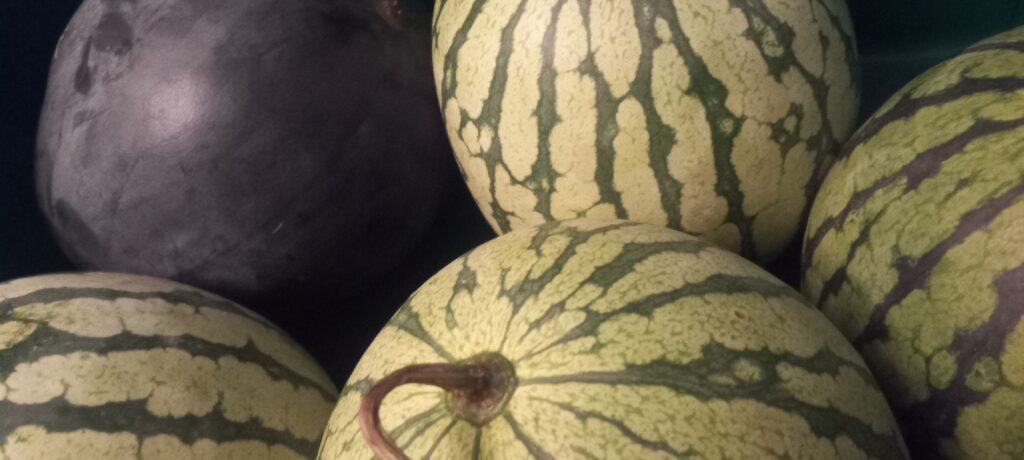
The aspect of CSA that gets less attention is the idea of shared reward. And that is what we are experiencing — in my opinion — this season. These last couple of weeks and if my crystal ball is any indication, the next few weeks as well, have been/will be incredibly productive. We have maxed out our storage space and used all our storage bins with all the produce we are harvesting each day. We are getting it out as quickly as possible yet we still run out of space every harvest day. I think having a big watermelon year has a lot to do with it. They take up a lot of space and are quite heavy.
The downside from the farm’s perspective on such an abundance is that with all that needs to be harvested we are not finding the time to do the other jobs that need doing. We only got through about a third of the hoeing of the fall brassicas. The leeks haven’t been weeded since sometime in late June. As I discussed in a prior newsletter, the garlic harvest got pushed out a bit, then we had the rain that made it even worse. Spending all our time harvesting and washing produce is making the future more challenging.
And the real question is: “Why so much produce this season? What’s different?” (Wait, that’s two questions). I have a few theories all of which are probably applicable — plus a few more I haven’t thought of.
Let’s start with cucumbers, zucchini and melons. We have seen very few cucumber beetles. They attack these specific crops and in past years their presence has been erratic. Some years like this year we’ve seen very few. Other years it seemed like it was snowing cucumber beetles. With the dearth of cucumber beetles this season the plants have produced beyond what we normally expect. The challenge now is how to not have cucumber beetles in the future. Seems like a winter project.

The second big factor in my opinion — and I hate to mention it because whenever I do it takes a bad turn — is we are more successful keeping the deer at bay. Our double layer fence, though not impenetrable, is dramatically reducing the deer damage. It makes one realize how much damage they were actually causing these last many years. I wish we could have figured this out earlier (knock on wood that I didn’t just jinx it again).
The third factor is our crew. We have four people who have worked here more than one season and another who has experience on other farms. Having so much experience makes the whole farming process so much easier. I don’t have to be involved in every activity or train on any new-to-them process. Having experienced workers is huge. Hopefully we can keep this going in the future.
Another big factor is the lack of destructive weather. Again, I hate to jinx it, but we haven’t closed our hoop house since we no longer had cold temps. Typically we have a number of storms that require us to shut the doors and roll down the side then hope the winds don’t get too high. We haven’t seen that type of storm yet. Hopefully we continue the trend.
Another big factor is just our experience. Though every year we encounter new difficulties, the number of new ones is becoming fewer. We’ve seen a lot of problems in the past and have solutions for many of them. The trick is to know when to apply the solution and this season we seem to be doing a good job. A good example was discussed in the newsletter about the crows eating our watermelons. Once we discovered the problem we quickly set up strings to limit the damage. It seems to have been quite effective.
Now this isn’t to say that every crop did or is doing well. The Spring brassicas had a horrible season. There are many factor contributing to it and I think I already discussed some of them. But one I probably didn’t mention is the immense flea beetle pressure. I haven’t seen this many flea beetles in a long time. We have an organic pesticide that can slow them down a bit but we didn’t have a lot of opportunity to use it this season. Just too many other things to do. So when we focus our resources elsewhere it seems Mother Nature focuses her resources on the areas we weren’t paying enough attention. And in the end, Mother Nature has far more time than we have labor so she will win every time.
But it is still a pretty great season, especially for our many wonderful members who have been though seasons of far less bounty. This season really shows off how when things go well the farm can produce an abundance of produce. And of course some past seasons showed the opposite.
But let’s enjoy the bounty we are now experiencing. And hope the success continues into the fall.
Recipes of the Week
Here is recipe for Tabouli. We have a lot of parsley and some mint so I hope we find the time to harvest it.
Tabouli Salad
Ingredients
- ¼ c bulgur wheat
- 2 firm ripe tomatoes chopped
- 1 cucumber chopped
- 1 bunch parsley chopped
- 6-10 mint leaves chopped
- 1 small sweet onion chopped
- salt
- 2 T lime or lemon juice
- 2 T olive oil
Instructions
- Prepare bulgar wheat per package direction.
- Place the chopped vegetables, herb and green onions in a mixing bowl.
- Add bulgar wheat and season with salt. Mix gently.
- Add lime or lemon juice and olive oil. Mix gently
- Cover and refrigerate for 30 minutes.
- Serve with pita, lettuce boats or as a simple side salad
Notes
Joke of the Week
Where do criminal watermelons live?
In seedy neighborhoods.
As always, send in your comments, questions, jokes because mine are getting worse every week, and anything else you think would be important for me to know!