
Just one announcement then on to the important stuff.
Still taking pint-size clam shell containers back. We are giving out around 300 clam shells filled with cherry tomatoes this week alone so getting some of them back would be very helpful!
What will we have this week?
If this week isn’t peak veggie then we’re in big trouble when it is! This week we will have melons, watermelons, carrots, peppers, onions, okra, zucchinis, lots of cucumbers, eggplant, tomatoes, lots of cherry tomatoes, tomatillos, some corn, and probably a few other things I’ve forgotten.
Just flowers this week.
Melon Talk
We started picking melons and watermelons this past week so I thought I would say a few things about them. First, if I was ever to write another newsletter about crops I don’t like to grow these would be among the candidates. But that isn’t the point of this section. So let’s get back to the important stuff about melons and watermelons.
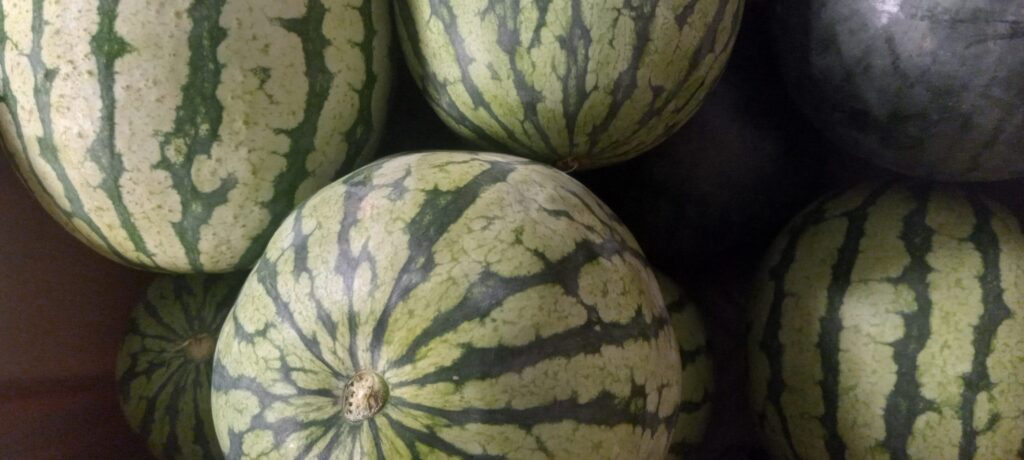
The two type of melons we grow are cantaloupes and honeydews. We also grow two type of watermelons — sugar baby and yellow doll. Of all these melons only the cantaloupes are climacteric. (As a reminder, climacteric refers to the ability to ripen off the vine). The honeydews and watermelons will not get any better no matter how long you leave them sitting around, so feel free to eat them soon!
So first let’s discuss the cantaloupes. With cantaloupes we may pick them under ripe (at 3/4s slip for those who need to know). We do this so they store longer and give you more freedom on when you want to eat them. To slow down ripening you can put them in the fridge. To speed up ripening leave them out on the counter. The softer the cantaloupe the riper it is. Smell alone won’t dictate ripeness. So leave them out for awhile and check on them often. Once they start softening you can decide if it is time to eat them.
Though cantaloupes ripen off the vine they do not increase their sugar content once picked. So if you want the best flavor with the most sugar content you have to pick them at full slip when it is fully ripe, but then you have to eat it very soon or it will rot. So we try for the happy medium 3/4 slip. Not quite fully ripe hopefully with enough time to produce ample sugars yet still able to be stored for more than a day or two.
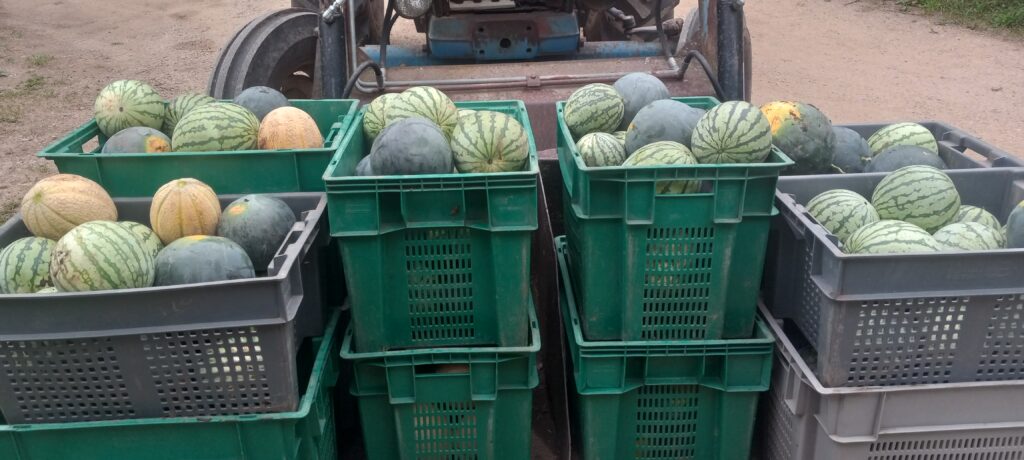
Honeydews do not ripen off the vine, which puts a lot of pressure on us to pick them at the right time. Unfortunately, for whatever reason, seed companies don’t always tell you what signs to look for to determine their ripeness. How odd is that? Thankfully with this newfangled AI stuff you can get this type of info no matter how inaccurate it may be. For our particular honeydew we believe they need to be picked when their skin turns a creamy white color. Of course trying to figure out what that means is an equal challenge. We tried one a couple weeks ago that looked creamy white to me but it was under-ripe. So we’ve left them out longer and waited for more creaminess and more whiteness. Hopefully we got it right this time since we harvested a few. If you get one of these melons it will either be the best melon you’ve ever had or taste like a store bought honeydew. I hope it is the former.
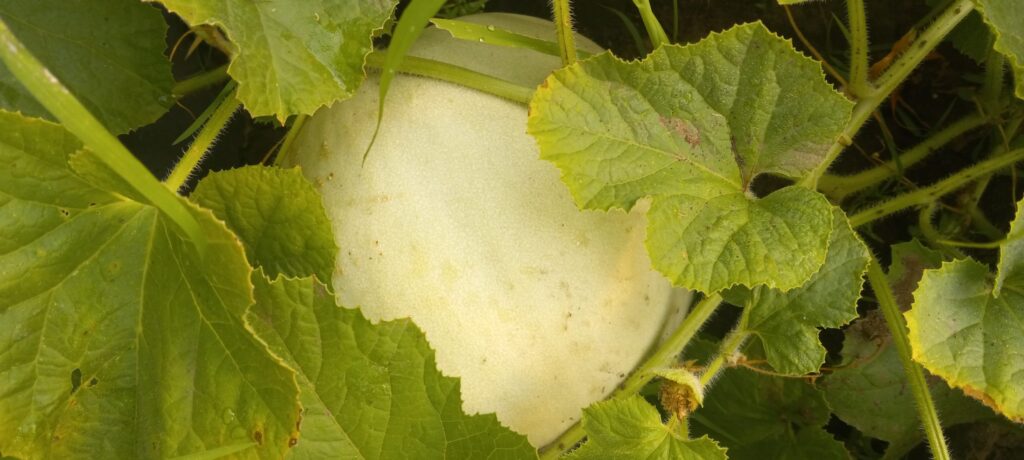
Watermelons for those who aren’t in the know, are the largest berry grown here on Earth. There may be larger berries on other planets but we haven’t found any yet. The darker green rind watermelon is a Sugar Baby. It is a delicious, sweet melon with traditional red flesh. Yellow Doll’s rind is a lighter colored green with tiger stripes. It has yellow flesh and is also quite sweet and tasty! Both have seeds. We’ve tried growing seedless watermelons a number of times and were unsuccessful. It seems every time we try growing seedless we have a general bad watermelon year so I think it has just been bad luck. Anyway, having seeds in your watermelon gives you the opportunity for seed spitting contests — and who doesn’t like a good seed spitting contest?
Cantaloupes and honeydews can be stored in the fridge. When honeydews are removed from the fridge they should be eaten fairly soon. Since we store them in the fridge if you get a honeydew I suggest you eat it soon after receiving it. Watermelons should be stored at the always available in every household temperature of 50-60 degrees. Refrigerator temperatures are too cold. But if you plan to eat the watermelon soonish, which is the only way to eat watermelon, you can store them at the more often found room temperature of 70-80 degrees. Once cut, if not consumed, the cut portion should be put into the fridge.
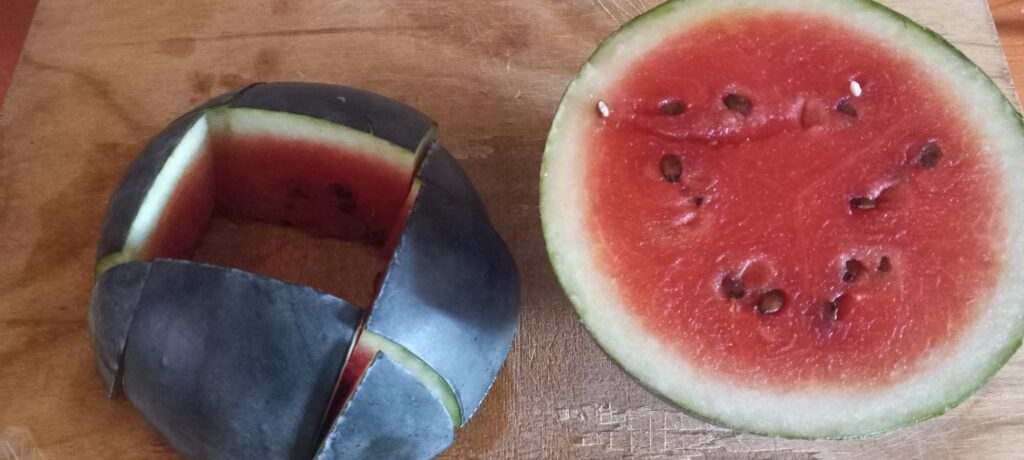
Speaking of cutting watermelons, most people do it wrong — in my opinion. I’ve found the best way to cut them is as follows. First cut it in half. Then lay the cut side down and cut the melon in a cross hatch pattern — basically cut it into square chunks. Then grab a chunk by the rind and eat it like a popsicle. It is far easier to eat with little watermelon juice smearing on your face than the more common half circle approach to watermelon slicing. However, with this “popsicle” approach there is always the issue of who gets the center piece. Give it a try. If you don’t like it you can always switch back.
Fruit Fly Traps
I’ve mentioned this a few times in past newsletters but it is always good to refresh our collective memories at this time of year. If you are having issues with fruit flies a simple trap can be setup that I guarantee will solve the fruit fly problem — at least it works here at the farm and in our house. Get a small jar, like pint size, and fill it to about an inch high with apple cider vinegar (not sure if other vinegars work). Then put one drop of dish soap in the jar. No need to stir. Just drop it in. Then sit back, grab a cold one and watch as the fruit flies fly into the jar, land on the surface and sink into the deadly vinegar. (Actually I think they drown. I don’t think the vinegar itself is necessarily deadly to fruit flies). If you want to learn more about how this works, feel free to check out this past newsletter.
Recipes of the Week
I probably should have put this recipe in last week’s newsletter when we had avocados in the FruitShare, but I didn’t have the recipe yet since we created it with the avocados from last week’s FruitShare. It was the best guacamole I’ve ever eaten I must say and it uses fresh veggies from the farm!

Guacamole
Ingredients
- 3 ripe avocados
- 1 tomato diced
- ½ medium red onion diced
- 1 clove garlic minced
- 1 lime juiced
- ½ tsp salt
- ¼ tsp cumin
- 2 tsp fresh cilantro chopped
Instructions
- Scoop out and mash avocados
- Mix in lime juice and salt
- Mix in remaining ingredients
- Enjoy with your favorite tortilla chips or tacos!
Glook
Ingredients
- 2 eggplants chopped into bite-size pieces
- 2 cloves garlic minced
- ½ lb okra stems removed and sliced into bite-size rounds
- 2 medium tomatoes chopped into bite-sized pieces
- 1 tsp coriander
- 1 tsp cumin
- 1 tsp sumac powder
- 1 tsp paprika
- 1 tsp chili powder
- lemon juice
- olive oil
Instructions
- Heat olive oil in large skillet over medium high heat
- Add eggplant and saute for a few minutes then add a splash of water, cover and steam to soften
- Toss in okra and add spices. Salt and pepper to taste
- Add tomatoes and cover to simmer for a few minutes
- Finish with a splash of lemon juice
- Optional garnishes/additions: fresh herbs, dukkah seasoning, feta cheese
- Serve over rice or couscous
This recipe was recommended by one of our members. She finds it quite refreshing and a good use for several of the many cucumbers we’ve been giving out. Win-win!
Here is another recipe recommended by one of our workers. Looks like a yet another good use for the okra!
Finally, here is another okra recipe that sounds delish, sent in from another farm member. Let me know if you like it!
Joke of the Week
What happens when life gives you melons?
You must be dyslexic.
As always, do not hesitate to send in questions, comments, suggestions, recipe ideas, or other interesting things.