
Happy New Year!
Sorry for the long delay since the last newsletter. Had to spend a bit of time getting this one ready for release.
Speaking of new year, we are still taking orders for 2026! We are ahead of last season, which is great, but that doesn’t mean we are sold out. So for you people who are waiting for the new year now is the time to sign-up!
We have most of our add-on shares available to order from our online store. Feel free to add ‘Shrooms, Fruit, Eggs, Flowers, Winter, Coffee or transplants to your account. We’re still waiting on 2026 prices for a few items.
Anyone interested in NutShare? We personally use a fair amount of nuts and seeds in cooking plus as a snack so I reached out to a local nut seller to supply us with nuts and seeds and surprisingly (not really) they are willing to work with us. My current plan is for two types of NutShares — nuts used for cooking and nuts for snacking. The main difference is the ones used for cooking won’t have salt or chocolate on them. The ones for snacking may have either or both I suppose. Let me know if you are interested. It would be something like a pound (except for the really expensive ones like pine nuts) of nuts every other week for nine weeks. The cost would be around $72.
Anyone interested in BeanShare? Since the nut company also sells dry beans I thought it would be interesting to do a dry bean share as well. Much like NutShare it would be a pound of dry beans, peas or lentils — mostly organic — every other week for nine weeks. The cost would be around $30. Let me know if you are interested!
Now on to Farm News!
Farm News
Since there isn’t a lot of exciting things going on right now to talk about I thought I would talk about the exciting things that happen in the summer but we don’t have time to talk about them. So in this newsletter I’m going to talk about one of the most exciting activities here on the farm – hoeing.
So let’s start by defining hoeing. The verb “to hoe“, according to Merriam Webster, means “to weed, cultivate or thin a crop with a hoe”. Urban dictionary has a far different definition. We use the Merriam Webster definition here on the farm. So basically when we are hoeing we are trying to remove or kill any weed that would take nutrients, water and sunlight away from our cash crop.
There are many type of hoes that perform differently and work in different situations. Let’s look at a few of them.
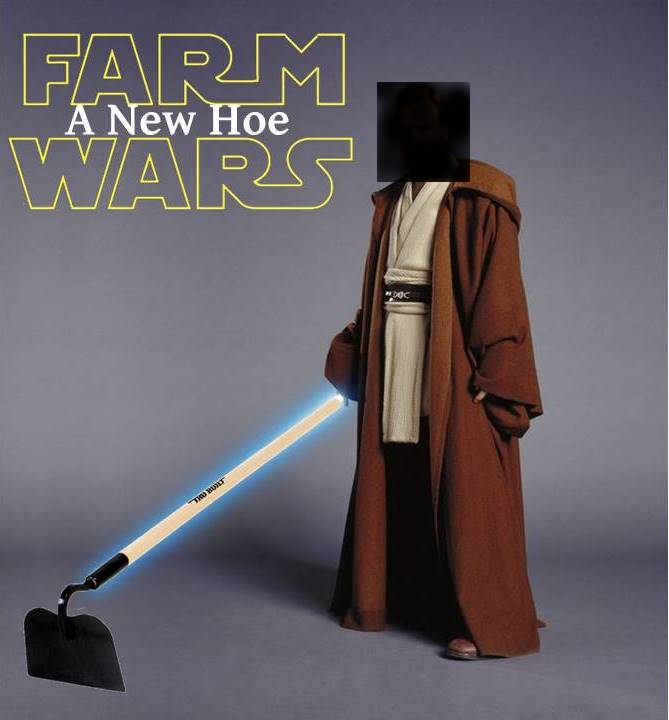
Most people’s idea of a hoe is a long handled tool with an angled blade on the end. You see this style a lot in cartoons. You’ve also seen this type of hoe in the movie franchise “Farm Wars”. The mode of operation of this type of hoe is a slicing motion into the ground with progress in the direction of the blade. Basically taking small slices of the earth as you move along. This cuts the roots and dislodges the weeds and if you aren’t careful the cash crops as well. It is a good approach where there is heavy weed pressure or deep rooted perennial weeds. We don’t use this type of hoe much.
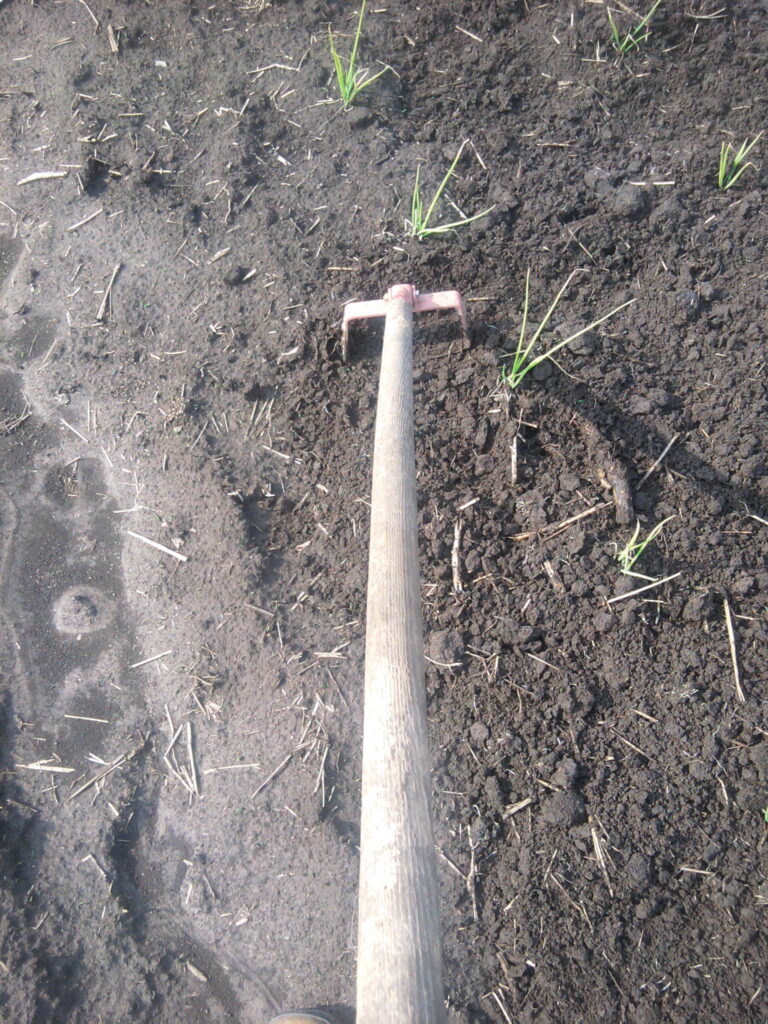
Our preferred type of hoe is called a stirrup hoe. Some people might think it is called a stirrup hoe because it stirs up the soil. Yes it does do that but the main reason it’s called a stirrup hoe is that it looks like the stirrups used in horseback riding. At the end of a long handle is a stirrup looking blade that is on a short swivel. Since we hire a lot of teenagers, we find training them on how to use this type of hoe is easy. By pushing and pulling the blade of the hoe through the soil the blade cuts the roots and dislodges the weeds. If used correctly it doesn’t stir-up the soil very much. The blade runs just beneath the soil excising the weeds from the ground. With this type of hoe more roots of the cash crop are preserved compared to the typical garden hoe. We find it is also takes less strength so we don’t get sore muscles and covers more ground faster. The downside is that some of the weeds could get dislodged then reburied allowing them to reroot. But that is true of all types of weeding.
For larger/longer areas we may use a wheel hoe. A wheel hoe is basically a stirrup hoe attached to the bottom of what kinda looks like a wheelbarrow chassis without the “tray”. By pushing and pulling the wheel hoe through the soil we cut the roots and dislodge the weeds. It is a great tool for weeding long, straight runs but can also be used wherever there isn’t a risk of cutting plants; being a larger tool it isn’t as nimble as a hand-held stirrup hoe. We use it a lot when we weed the edges of planting beds or when we weed direct seeded crops like beans or peas.
The final stand-up style hoe type we use is called a collinear hoe. It looks like the typical garden hoe but with a much, much smaller blade. It is used for really close cultivation. We sharpen the blade to make it easier to pull through the soil. But we also sharpen the edge of the blade to create an even smaller hoe. This “side” blade is only about an inch wide so we can use it to weed between closely planted plants like beets. The downside of this type of hoe is that it only works in one direction — pulling. So any movement in the forward direction is wasted. The stirrup hoe and wheel hoe cultivate in both the push and pull directions, therefore not a lot of wasted effort.
We also use a couple of smaller, hand-size hoe like tools when we are weeding by hand. We find them useful in specific situations but would always prefer to weed/hoe standing up. Standing up hoeing trumps kneeling hoeing. Crawling around on the ground is hard on the knees.
We spend a lot of money on hoes and they are worth every penny. From a cost/benefit analysis there probably isn’t a more cost effective tool on the farm.
Joke of the Week
What’s the best part of farming?
Getting down and dirty with your hoes.
As always, feel free to send in questions, comments, suggestions, share orders or anything else you think I should redact. And if you didn’t notice, you can unredact any of the redactions by clicking on them.