
Read how a couple of clever fellows (ok, one clever fellow and his able-bodied assistant) saved the whole season in one afternoon. But first a couple of announcement.
We are still taking orders for shares this season. We’ve had some success as of late as people realize picking up produce from a local farm or drop site presents less risk of catching something nasty than going to a crowded grocery store where who know what sneezed all over the produce. I don’t know if that’s true (its true) but whatever reason they decide to join us is fine with me. Spread the word!
Don’t forget to pay for your shares. If you need a payment plan please let me know.
Don’t forget to order your delicious, certified organic fruit and coffee. What is life without fruit and coffee?
Farm News
tl;dr Everything on the farm is going great! (Never understood why they put this at the end of a long story. It should be here upfront so you can decide whether to spend the time reading it).
So last weekend I walked down to the greenhouse as usual to check on the plants and water them if necessary. It was a beautiful, crisp Spring day with sunshine and light winds. The kind of day you think, “It’s good to be a farmer!”
I arrived at the greenhouse, opened the door and saw all the plants. Everything looked great, but it didn’t feel right. Something was off. It was like there should have been ominous music playing in the background yet instead all I heard were the birds. What was it that just didn’t feel right?
And then it hit me. The inside of the greenhouse was the same temperature as outside of the greenhouse. That is not the way it is supposed to work during this time of year! It should be warmer. And this time of the morning much warmer. But isn’t that the heater I hear running? Why yes, yes it is. Huh? is about all I could think at that point.
So I walked to the far end of the greenhouse, the end where the heater is, and held my hand in front of where you typically feel hot air coming out. The air was coming out but it was not hot. It was not even warm. It was in fact the same temperature as the rest of the air in the greenhouse, which as I mentioned before was the same temperature as the air outside the greenhouse. Being the brilliant, highly educated person I am I thought, “Something is wrong.” Quickly followed by, “I think its the heater.” And with that I was no longer thinking how nice it is to be a farmer.
Fortunately one of our members, who has asked to remain nameless so as not to besmudge his professional reputation, was coming over later that day to help plant seeds. For the sake of this newsletter we will call him MacGyver. Little did he know he was soon to be brought out of retirement.
I texted him to let him know the situation and we scheduled a time for him to take a look. Prior to his arrival I removed my farmer overalls and replaced them with my HVAC coveralls and started hitting stuff on the heater with my pruning clipper shaped hammer. I also turned on and off the thermostat many times. These two activities gave me something to do while I cursed silently to myself.
Anyway, once help arrived we got to work. The first thing to do was to turn the thermostat on to call for heat. It kept calling and calling but the heater wasn’t answering, at least not with heat. We used the volt meter (a sophisticated device used by farmers to find new things to swear at) to measure voltage in all the usual places one would find voltage and after much discussion and various trials we determined the heater had plenty of voltage in all the right places if you know what I mean. (Who has the song, “Looking for Voltage in all the Right Places” going through their heads right now?) So that leads to only one possible conclusion, something is broken.
With our two brilliant minds we determined the thing that was broken was the gas control module. I don’t understand how that is possible since hitting it with a pruner shaped hammer didn’t fix it. But voltage meters don’t lie so it had to be the problem.
Now here is where professional help comes in handy. You see this all occurred on a Sunday and even in non-pandemic times getting a new gas control module on a Sunday was not possible. So our only hope was to repair the one we had. I know what all you HVAC people are thinking, “It can’t be done.” “Ha!”, I say. Let us farmers show you how to do your jobs.
Step one was to acquire a safety screwdriver set since the insides of the gas control module are not to be tampered with (by non-farmer types of HVAC specialists). Luckily my professional helper had such a screwdriver set, not with him of course but he did have one. After a quick drive home and back we got to work. Darn. These safety screws are not typical. They only have five lobes not six like the screwdriver set we have. Now what?
Being the ingenious fellows we are, through the use of a few tools including but not limited to a pair of pliers, a hammer, a punch and a small flat head screwdriver we were able to remove the “tamper-proof” screws. Once we opened up the control module we fired up the voltage meter once again to check the solenoid windings. Fortune fell upon us once again as they all tested fine. Nothing good can come from bad solenoid windings.
So, the problem had to be between where the voltage went into the control module and where is was supposed to go to the solenoids. We noticed there was a small printed circuit board between the two and as we removed it from its tamper-proof location we discovered two of the connections were damaged. How they got damaged is anyone’s guess but I have to believe it had something to do with all the bug parts found inside the tamper-proof cover. Didn’t these bugs know this is tamper-proof? And where did they get the correct safety screwdrivers.
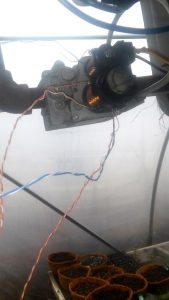
Now this next part is where MacGyver comes in. First he sent me off to look for something he probably didn’t need so he had time to think and probe this circuit board without some yahoo farmer asking a lot of questions and interrupting his thoughts. When I returned with the thing we probably didn’t need he said, “If we solder wires between these four places on the circuit board to the four ends of the solenoid windings the heater should work”. I’ve heard that before but it was better than the alternative of moving all the plants inside just before sunset, so we got to work. After a quick few solderings we were back in business. The heater was replying to the call for heat with heat. The plants were no longer in danger of freezing. And all that was left was to decide if this Rube Goldberg contraption was sufficiently stable or do I spend hard earned dollars to buy a replacement module. The true farmer in me felt that this fix was far superior to other “fixes” we rely on every day (probably one of the reason farming is one of the most dangerous professions). Why spend the cash? The more cautious HVAC technician in me said, “spend the money. We get a cut of everything we sell!” Our compromise was to spend the money but don’t pay for the expedited shipping. Seemed to be a good compromise. It’s good to be a farmer.
As always, do not hesitate to send in questions, comments, suggestions, jokes, brain teasers and checks for the remaining balance on your account.