
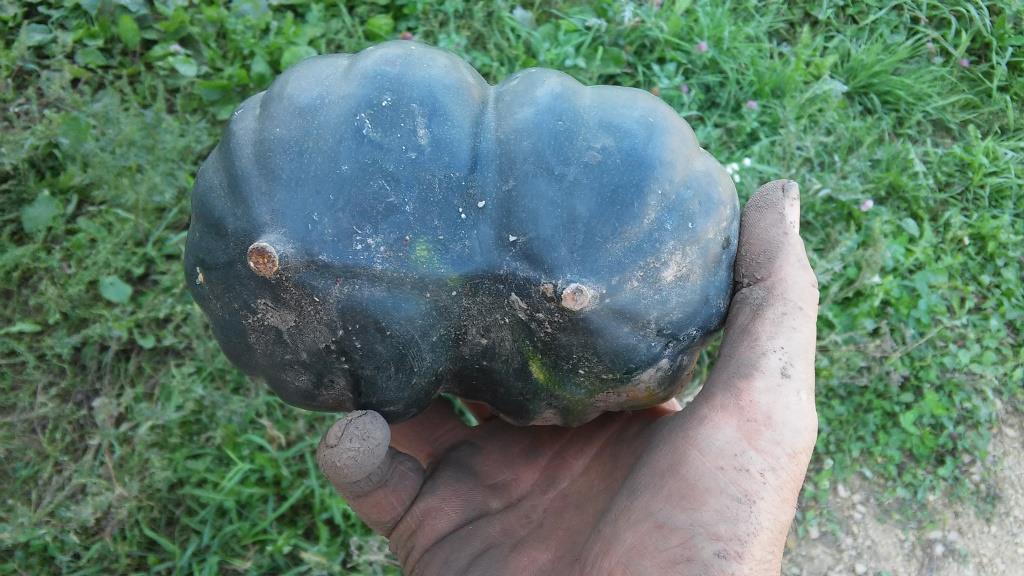
Due to overwhelming demand (one person asked me last week) we have started to harvest the winter squash and will be giving it out this week. The calendar says it is time to harvest but the weather begs to differ. I like to harvest winter squash (from now on referred to just “squash” so I don’t have to keep typing winter) after the vines have fully died and the weather turns cool. Dead vines are much harder to trip over and cool weather makes it more comfortable to haul 50-70 pound bins of squash out of the field. Plus, with dead vines it is easier to find all the squash and not accidentally step on one and squash it. But if we don’t start harvesting it now and we get no frost until October we will suddenly find ourselves overwhelmed with squash. So it was time to start the harvest to calm the overly demanding crowd.
The first two squash we harvested are spaghetti and acorn. Most people are quite familiar with acorn squash; they are the squash shaped like overly large acorns (or possibly like two overlarge acorns). Acorn squash do not need curing like some other squash do. In fact, storing them in a warm spot for a few weeks makes them stringy. So we like to give these out early in the squash season. You cook acorn squash like any other squash, e.g. roasted in the oven.
Spaghetti squash is a unique squash. The flesh of the spaghetti squash forms strands that resemble spaghetti, or so they say. I think it isn’t that spaghetti-like but it certainly does have a different texture than other squash. We typically just boil it in a large pot of water until it can be pierced with a knife. You can also microwave it for a faster meal. Roasting it in the oven like other squash will give it a more caramelized taste. Typically you would cut the squash in half and clean out the seeds prior to roasting it. All these methods work great. Once cooked we cut it crosswise (you probably already cut it lengthwise if you are roasting it but no big deal). If you cut it lengthwise you cut across the strands and shorten them, but so what. Once cut in half we scoop out the seeds then shred the flesh out with a fork. Use it like spaghetti or just put some butter and parmesan cheese on top. Delish!
We will most likely have squash for the rest of the season so get out your squash recipe books.
Garlic planting party is still on for Saturday October 10th from 2:00 to 5:00 with bonfire and potluck to follow. This is a great way to get involved in the farm and meet fellow farm members. Plus think of all the fresh air and sunshine you’ll get! Kids are welcome. Adults too! Some tasks do not require bending or stooping so can be performed by the less agile among us. Let me know if you can make it!
The Spud Fund continues to grow. We are now over $120. Woo-hoo! For those still unfamiliar with the Spud Fund it is our way of raising money to purchase seed potatoes for next season by selling extra potatoes from this season. The need to buy new seed potatoes is due to the presence of late blight on our potatoes and tomatoes. If you are interested in funding the Spud Fund all you need to do is purchase extra potatoes whenever you need extras. The price is a low $1/pound. For delivery members just send me an email with the quantity you would like and we will send them off with your next delivery; you can follow up with payment. On-farm members can just serve themselves and leave the money behind.
Speaking of potatoes, new this week are the russet potatoes. These potatoes are less waxy and dense compared to the earlier potatoes and will make great mashed or baked potatoes.
Also speaking of potatoes, so far we have found minimal storage loss due to the blight. I estimate we lose about a pound of potatoes per 50 pound bin, so about two percent. We have found some varieties of potatoes are more susceptible in the ground; when we are harvesting the potatoes some have more rotten spuds than others. We’ve also noticed the rotten ones seem to congregate close together. So we’ll put a few extra pounds in the winter storage shares to compensate for the anticipate loss.
Speaking of winter storage share, we will start assembling and delivering them shortly. We have the onions, garlic and shallots processed; we need to put them into bags and send them out. The winter squash will be another couple weeks with the potatoes to follow shortly thereafter. We still have plenty of shares left if you would like to add one. A full share is 20# of squash, 20# of potatoes, 5# of onions, 2# of garlic and 2# of shallots. A half share is half of that.
Since we did not sell out of winter storage shares we will split up the contents so that you can purchase each item separately. Let me know if you’d like to purchase any extra onions, shallots, garlic, squash or potatoes.
What will we have this week? Well, the garlic, onions, potatoes and carrots keep coming. As mentioned above we are starting to give out winter squash. The peppers are still going strong. We have some large fall cabbages ready to harvest. We’ll continue to harvest the kale, celery and chard as needed. There are also a few odds and ends like cucumbers (they are nearing the end), cherry tomatoes (they are past the end but we’ll get whatever we can find out there), beans (almost at their end), tomatillos (they look like they will keep going until frost), and maybe eggplant (the plants look fabulous, flowering, however with very few fruit). Next week we should be harvesting the fall salad mix, beets, Napa cabbage and possibly kohlrabi. The broccoli is looking great; we just need for it to start heading up!
The flowers are shutting down for the season, so no FlowerShare this week. The large pumpkins are still greenish and maturing. Once they are orange we will start harvesting them and give them out. Same with the gourds.
FruitShare is a mixed box of apples, pears, Asian pears, plums and grapes. Delicious!
EggShare and CheeseShare are also this week.
That is all for now. Sorry for the delay in getting this newsletter out. It didn’t rain earlier in the week.