
A special “Thanks” to Jan, Val and Dennis for sitting around and talking while here at the farm this past weekend. They also processed some garlic while sitting around which was even more helpful. If you’d like to take part in this whole sitting around and processing garlic thing we still have plenty of opportunities. Just let me know when you have an hour or two to spare and I can set you up with a chair and clippers. All help is greatly appreciated!
We are still taking pint size clam shells back. We are just about out of the good clam shells so we will be transitioning into the frustrating-to-use containers we bought a while ago when we couldn’t get the clam shells. So send/bring back the calm shells!
Just a reminder for the delivery folks: if you want hotter than jalapeno or Serrano peppers let me know. We don’t want to send you the 1,000,000 Scoville unit peppers if you don’t want them. On farm people can grab some when they are available in the pick-up tent.
What will we have this week?
More watermelons, honeydews and cantaloupes. They are winding down but not until after this week. So get your melon baller and fruit salad recipes ready! We also have lots of beans — green, yellow (also known as wax) and Roma beans. The Roma beans are just like green beans but flat. Use them as you would use green beans. Wax beans are also just like green beans but are yellow. I’m not sure who coined the term wax beans but I find the term unappealing. Anyway, we’ll also have cucumbers (these are winding down as well), some corn, some zucchinis, lots of onions, lots of cherry tomatoes, tomatoes, tomatillos, eggplants, lots of okra, peppers and all the other things I have forgotten.
I believe it is only a FlowerShare week this week. No other extra shares.
A Quick Note About Onions
We are in the transition period with the onions as they go from fresh onions to dried onions. This happens when the onions out in the field die back. At this point we want them to dry so that they store reasonably well; we don’t want to add moisture if we can help it. Therefore, we typically won’t wash onions at this stage. Now at some point in the future the onions will be harvested and cured — stored in a warm, dry place — to make the onion seal the stem for longer storage life. This dries out the outside skin layer which we can then rub off and make the onion look fairly clean without having to immerse them in water. But the onions we harvest today won’t have gone through the curing process so the skins are still tight to the bulb and therefore the bulbs may have some dirt on them still. I recommend you wash off the dirt just prior to using the onions. Or you can cure them yourself by leaving them in a warm, dry spot (for delivery members you should remove them from the bag) for a week or two then rub off the outside skin. Let me know if I made this confusing enough or if I need to add more obfuscation.
Farm News
Let’s talk sweet corn.
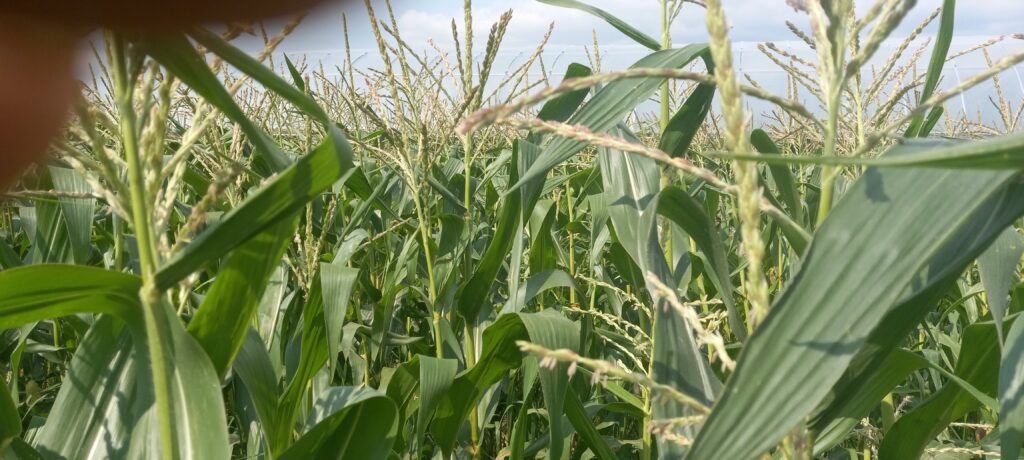
Of all the veggies we grow sweet corn is the most resource intensive. Some people don’t realize that we only get one ear per stalk of corn. Yes, just one ear from the plant that is likely one of the larger vegetable plants we grow. People may also not realize that corn requires a lot of space. Probably equivalent to winter squash from a per pound basis.
If you read the literature on growing sweet corn you’ll find it talks about direct seeding the corn at a foot apart in rows 3 feet apart. I don’t think we do any of this. First of all we transplant corn. Why? Since we grow things organically we can’t rely on chemicals to prevent the seeds from rotting in the field. By planting the corn in the warm confines of the greenhouse we get far better germination than we’d get in the cold, harsh, Spring climate of the great outdoors. We can regulate the temperature and moisture better and the result is far better germination. And equally important is we can plant the corn earlier than we can if we direct seeded it outdoors.
Transplanting corn is not without it’s own difficulties. One thing is you have a relatively small window in which to transplant the corn seedlings. If the seedling is too small the root ball doesn’t hold together well and the roots break off during the transplanting. This can create stunted plants. If you wait too long the roots start emerging though the hole in the bottom of the cell. This makes the plant more difficult to remove from the tray and again can result in broken roots. Sweet corn grows fast so going from too small to too big can be only a couple of days if the weather is hot. We typically see the window of opportunity to be about a week. Sometimes this isn’t enough if we have a particularly wet spell and can’t get it into the ground due to too much rain.
We also plant two seeds per cell. Why? Because we can get twice as much corn in the same amount of space! But also because the corn root ball holds together better when the plants are small. Two plants, twice the root ball. This allows us to transplant the plants when they are smaller and gives us a bit more wiggle room for transplanting.
We transplant them at one foot spacing which is what the experts typically say is the spacing for a single plant. Planting farther apart is something we’ve considered but havien’t done the experiment yet. In theory we should plant the two plants two feet apart giving them the space they require. But that would take up twice the space — something corn already uses too much of.
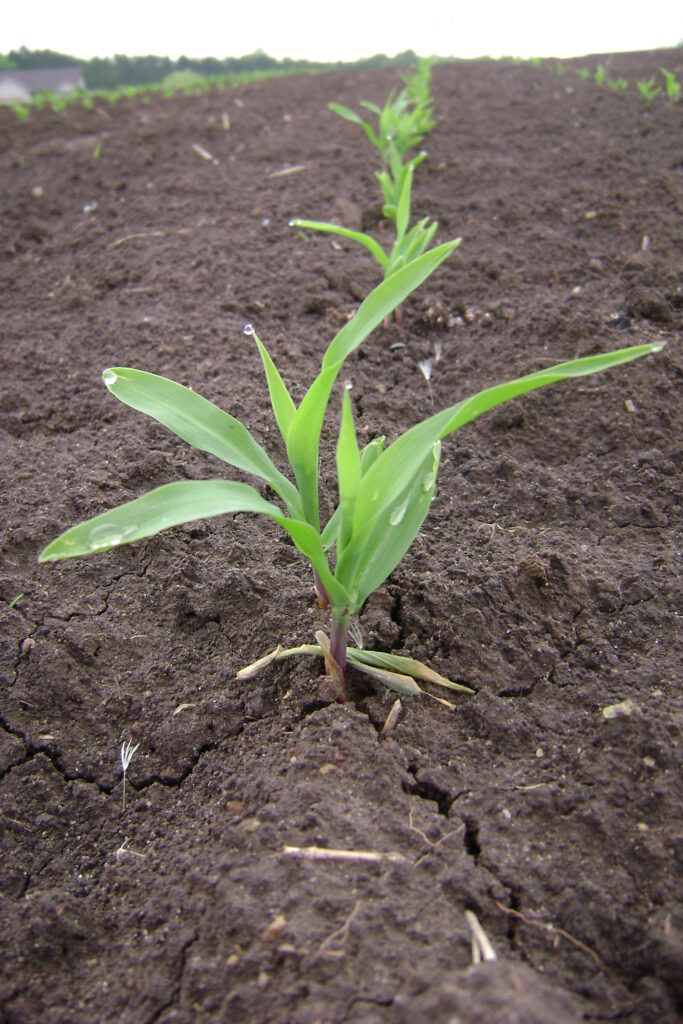
We plant the rows two feet apart in the bed and the beds are six feet apart on center. This gives us good spacing to walk down between the rows to allow for easier harvesting, which we do by hand. Large scale sweet corn farms use machines to harvest the corn. Ours is all done by hand.
Corn is also a large consumer of nitrogen. Organic nitrogen is far more expensive than chemically derived nitrogen so we prefer to use only as much as we need. The large scale commercial growers can use anhydrous ammonia or other cheaper nitrogen source. For those of you far removed from your chemical engineering studies I’ll just remind you that the Haber-Bosch process made nitrogen cheap for farmers, though not us organic farmers.
Then of course, it likes water — lots of water. Typically it needs 2-3 times what other veggie crops need. Like I said, it is a resource intensive crop.
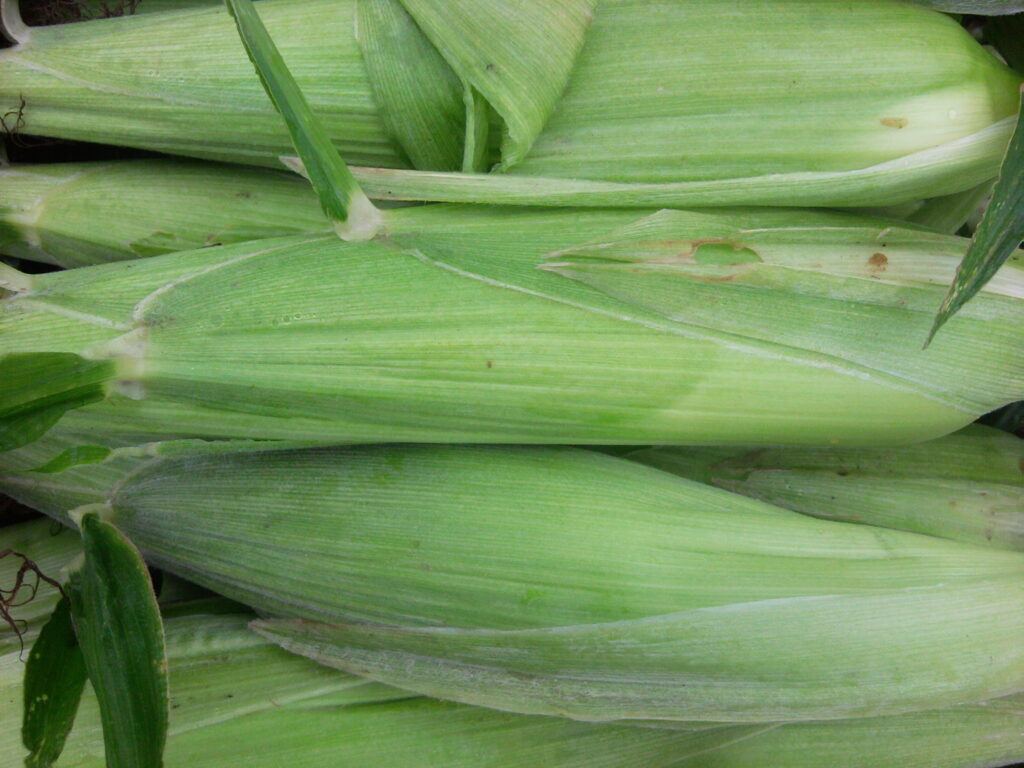
If you think about the amount of actual food you get from an ear of corn you realize how small it is. The ear is maybe 50% edible, with the rest being the cob and the husk (I think it is far less but the internet says its closer to 50%). So looking at the total plant we’re talking, what at most 10% of the plant’s weight is the edible part we eat? And to eat it we have to harvest and carry twice the amount of weight (the whole ear). What a ridiculous vegetable. But man, when it works out it is one tasty — though barely nutritious — veggie.
From a pest standpoint, there are numerous creatures who like sweet corn as much as we do. High on the list is corn earworms. These are the ugly caterpillars that only a mother can love. They infiltrate the ear and start eating the corn from the inside out. This is one of the pests for which GMO corn was created. By manipulating the genome scientists were able to make the corn create a protein that kills the corn earworm much like the organic pesticide bt. There is now sweet corn on the market that has this gene so if you want to avoid GMOs you should buy organic corn or just keep being a Fresh Earth Farms member since we do not grow GMOs.
We handle the corn earworms by starting our plants earlier to hopefully avoid the time earworms mothers are flying around laying eggs. This doesn’t always work but is about the best we can do.
The other sweet corn pests are deer, raccoons, birds, neighbor children (jk) and any other creature that like the taste. Unfortunately these pests are difficult to keep out of the corn patch and can do significant damage in a short amount of time. How many of us have seen deer taking one bite out of each cob trying to find one that is ripe? I see a lot of raised hands out there. They are quite frustrating animals to deal with. Why can’t they just wait until the corn is ready?
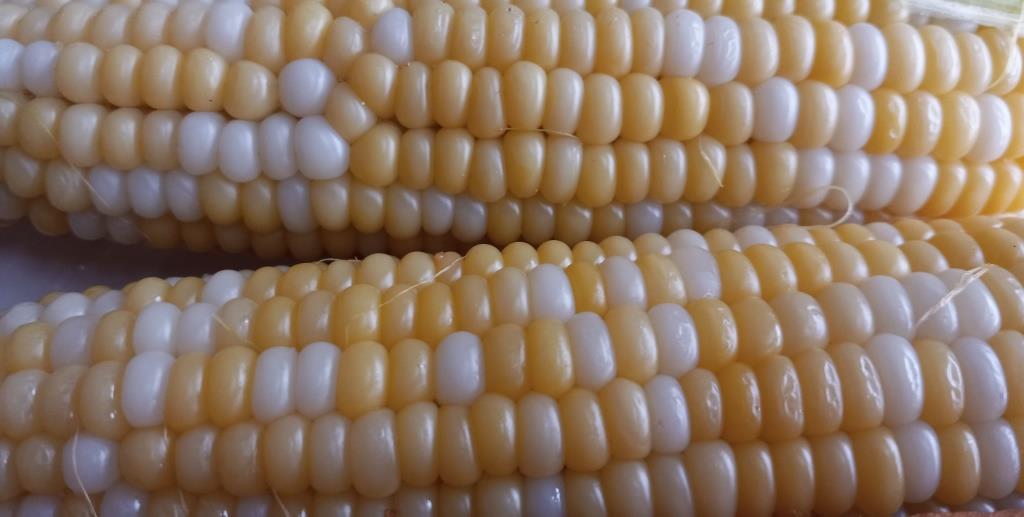
Anyway, as you can imagine, corn ranks high on the list of less favorable plants to grow. But it also ranks high on the most favorable plants to eat, and that is why we continue to grow it year after year.
Recipe of the Week
Don’t really have a recipe this week.
Joke of the Week
What did the baby corn say to the mama corn?
Where’s popcorn?
Send in your questions, comments, suggestions, pint-size clam shells and anything else you think would be worthwhile.